WEEK OF JAN 18 – 24, 2025

DeepSeek gave away o1-class reasoning — the same week Washington committed $500B and scrapped its safety order

An MIT-licensed 671B model landed on Monday. By Thursday the US had announced half a trillion dollars of compute and deleted the frontier-safety review regime it had created fifteen months earlier.

DeepSeek-R1 shipped as open weights under the MIT license — 671B total parameters, 37B active, 128K context — claimed on par with OpenAI's o1 on math, code and reasoning at a fraction of the API price, alongside six distilled dense models from 1.5B to 70B.

Within 72 hours: Stargate was announced at the White House with $100B committed immediately, and Trump signed EO 14179 revoking Biden's AI safety order. OpenAI also shipped Operator, a cloud browser your agent drives, with prompt-injection mitigations security researchers immediately doubted.

FRI · Jan 24, 2025computemetacapexdata centers

Meta sets 2025 capex at $60–65B, targeting 1.3M GPUs

Zuckerberg announced that Meta will spend $60–65 billion on capital expenditures in 2025, up from $38–40B in 2024 and well above the roughly $51B Wall Street consensus, building a 2GW+ data center, bringing about 1GW of compute online this year and ending 2025 with more than 1.3 million GPUs.

He called 2025 a defining year for AI, predicted Llama 4 becomes the leading state-of-the-art model, said Meta AI should serve a billion-plus people, and said Meta is building an AI engineer that will start contributing increasing amounts of code to its R&D efforts. Meta shares closed at a record.

Meta sets 2025 capex at $60–65B, targeting 1.3M GPUs
image.cnbcfm.com

WHY IT MATTERS

The compute side of the week's contrast: closed labs answering an open-weight cost shock with more silicon, not cheaper models. It is also a bigger number than the entire 2024 frontier-training spend of most labs, placed days after R1 showed o1-class reasoning under an MIT license.
THU · Jan 23, 2025agentsagent harnessprompt injectionbenchmarksopenai

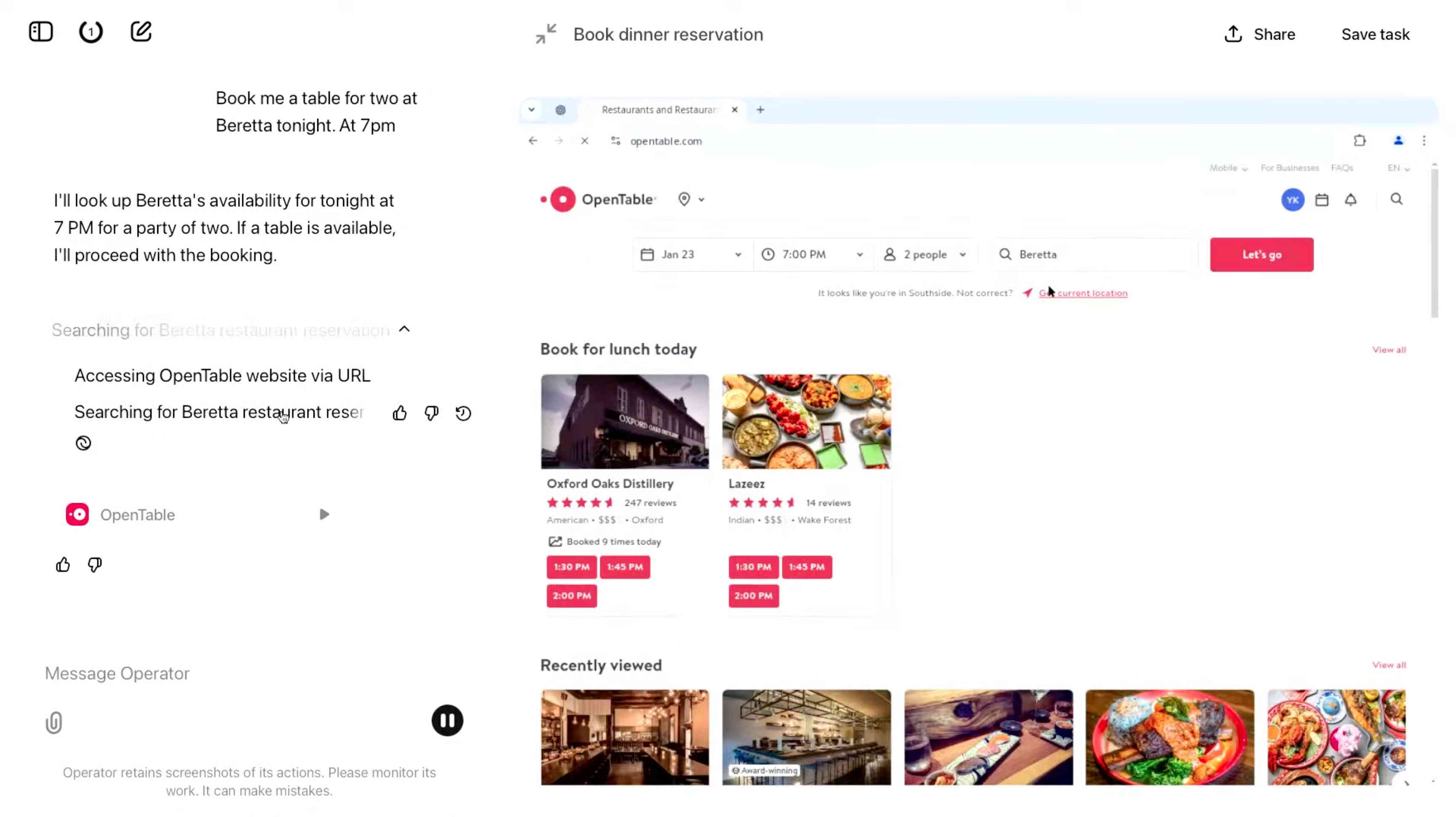
OpenAI ships Operator and the Computer-Using Agent: a cloud browser your agent drives

OpenAI released Operator as a research preview for ChatGPT Pro users in the US — a cloud-hosted Chrome instance the model drives by screenshot, typing, clicking and scrolling, with no site APIs involved. It is powered by CUA, which pairs GPT-4o vision with RL-trained GUI reasoning.

It set state of the art on computer and browser-use benchmarks: 38.1% on OSWorld against a prior 22.0% and a 72.4% human baseline, 58.1% on WebArena, and 87% on WebVoyager. The harness-level safety design is the interesting part: cautious navigation against prompt injection, a separate monitor model that ingests the screenshot and pauses execution on suspicious content, takeover mode so passwords and card details never enter the model context, restricted site categories, and a system card rating autonomy risk as Low.

OpenAI ships Operator and the Computer-Using Agent: a cloud browser your agent drives
static.simonwillison.net

WHY IT MATTERS

The reference harness design for the whole browser-agent category this year — treat its eval numbers and its prompt-injection posture as the baseline your own agent stack gets compared to. Simon Willison's reaction was the fair counterpoint: indirect prompt injection from a hostile page is exactly the failure mode that broke Claude Computer Use in 2024, and the mitigations are ML classifiers, not a sandbox boundary.

THU · Jan 23, 2025regulationpolicyexecutive ordersafety

Trump signs EO 14179, revoking Biden's AI safety order

Executive Order 14179, Removing Barriers to American Leadership in Artificial Intelligence, declares it US policy to sustain and enhance America's global AI dominance, revokes Biden's EO 14110 of 30 October 2023 — the Safe, Secure and Trustworthy AI order that created reporting duties for frontier models — and orders agencies to identify and suspend, revise or rescind actions taken under it.

It also instructs an AI Action Plan within 180 days and directs OMB to revise its AI memoranda within 60 days.

WHY IT MATTERS

The dated primary source for where US frontier-AI policy reset — no reporting or preemption frameworks survive it, and everything downstream this year cites it. It arrived within 72 hours of an unaffiliated Chinese lab publishing MIT-licensed weights matching o1-class reasoning, and two days after the White House announced $500B of private AI infrastructure.

WED · Jan 22, 2025fundingindustryanthropicgooglevaluation

Google adds another $1B to Anthropic

Google agreed to invest more than $1 billion more in Anthropic, on top of the roughly $2B it had already put in and its stake of about 10%, confirmed by CNBC after an FT report.

It lands alongside Anthropic's late-stage talks to raise about $2B at a $60B valuation led by Lightspeed, and after Amazon's additional $4B in November 2024. CNBC's source said Anthropic's revenue hit an approximately $1B annualized run-rate in December, roughly ten times year over year, mostly enterprise.

WHY IT MATTERS

Two hyperscalers now fund the same safety-focused lab, and the valuation jump is the clearest read on what enterprise demand was priced at going into 2025. The defensive move against the week's open-weight shock is to buy equity in a rival lab rather than to open-weight your own models.

TUE · Jan 21, 2025computedata centersstargateopenaisoftbankcapex

Stargate announced at the White House: $100B now, up to $500B over four years

Trump announced Stargate in the Roosevelt Room with Sam Altman, Larry Ellison and Masayoshi Son: a new company intending to invest $500 billion over four years in AI infrastructure in the US, starting with $100B deployed immediately. Initial equity funders are SoftBank, OpenAI, Oracle and MGX, with SoftBank holding financial responsibility and OpenAI operational responsibility.

Buildout starts in Texas; Ellison said 20 data centers of roughly 500,000 square feet each are planned. In parallel Microsoft reset its OpenAI terms: a new large Azure commitment and IP and revenue-share continuity through 2030, but exclusivity on new capacity replaced by a right of first refusal.

WHY IT MATTERS

The compute-commitment side of the week, and a structural change that mattered more than the headline number — losing capacity exclusivity let OpenAI buy compute from anyone. Note the sequencing: this half-trillion-dollar commitment was announced the day after an MIT-licensed model from Hangzhou matched o1 on reasoning benchmarks, which is precisely the argument DeepSeek's release undercut.

MON · Jan 20, 2025open weightsdeepseekreasoningrlself-hostingdistillation

DeepSeek-R1: MIT-licensed open weights at o1-class reasoning

DeepSeek released R1 as open weights on Hugging Face under the MIT license — 671B total parameters, about 37B active per token, 128K context — plus R1-Zero, which is pure reinforcement learning with no supervised cold start, and six distilled dense models from 1.5B to 70B built on Qwen and Llama checkpoints.

The model card claims performance comparable to OpenAI's o1 across math, code and reasoning, with AIME 2024 at 79.8 and MATH-500 at 97.3. DeepSeek-R1-Distill-Qwen-32B is claimed to beat o1-mini, and coverage put API pricing roughly 90 to 95% below o1. The paper's key claim is that reasoning behavior emerged from large-scale RL without human-labeled reasoning trajectories.

WHY IT MATTERS

The event the rest of the week is a response to — the point where an MIT-licensed model became the price-setting alternative to closed frontier reasoning. Commercial use, self-hosting, fine-tuning and distillation were all permitted, which sets a hard cost floor under closed reasoning APIs, makes a 37B-active model self-hostable on serious single-node hardware, and hands every lab and enterprise a distillation source.