WEEK OF JUL 18 – 24, 2026

Near-frontier intelligence at half price, and the first AI copyright case closes

Anthropic put frontier-class coding within reach of a mid-tier budget, Google flooded the cheap tier, and a $1.5B settlement set the price of the piracy claim.

Anthropic closed the week with Claude Opus 5, a near-Fable-5 model at half the cost that becomes the default on Claude Max. Google shipped three Flash-tier Geminis while confirming its most ambitious pre-training run yet, for Gemini 4.

Poolside released a 118B open-weight coding model small enough for a desktop, Cursor turned Auto mode into a real model router, and a federal judge gave final approval to Anthropic's $1.5 billion author settlement — the largest known copyright recovery in US history.

FRI · Jul 24, 2026modelsanthropiccodingpricing

Anthropic ships Claude Opus 5: near-Fable-5 intelligence at half the price

Anthropic released Claude Opus 5, presenting it as close to the frontier intelligence of Claude Fable 5 at half the price and the new state of the art on coding and knowledge-work evaluations such as Frontier-Bench v0.1 and GDPval-AA, though it remains behind Mythos 5 on cybersecurity tasks.

Opus 5 more than doubles Opus 4.8's performance on Frontier-Bench v0.1 at a lower cost per task, and at max effort lands within 0.5% of Fable 5's peak CursorBench 3.2 score at half the cost per task. It is now the default model on Claude Max and the strongest model on Claude Pro, with an effort setting that lets users trade tokens for speed and cost.

Anthropic ships Claude Opus 5: near-Fable-5 intelligence at half the price
cdn.sanity.io

WHY IT MATTERS

A frontier-class coding model at half the price resets the cost-per-task math for agentic coding, which is exactly where harness spend piles up.
WED · Jul 22, 2026agent harnesscursortoolingcost

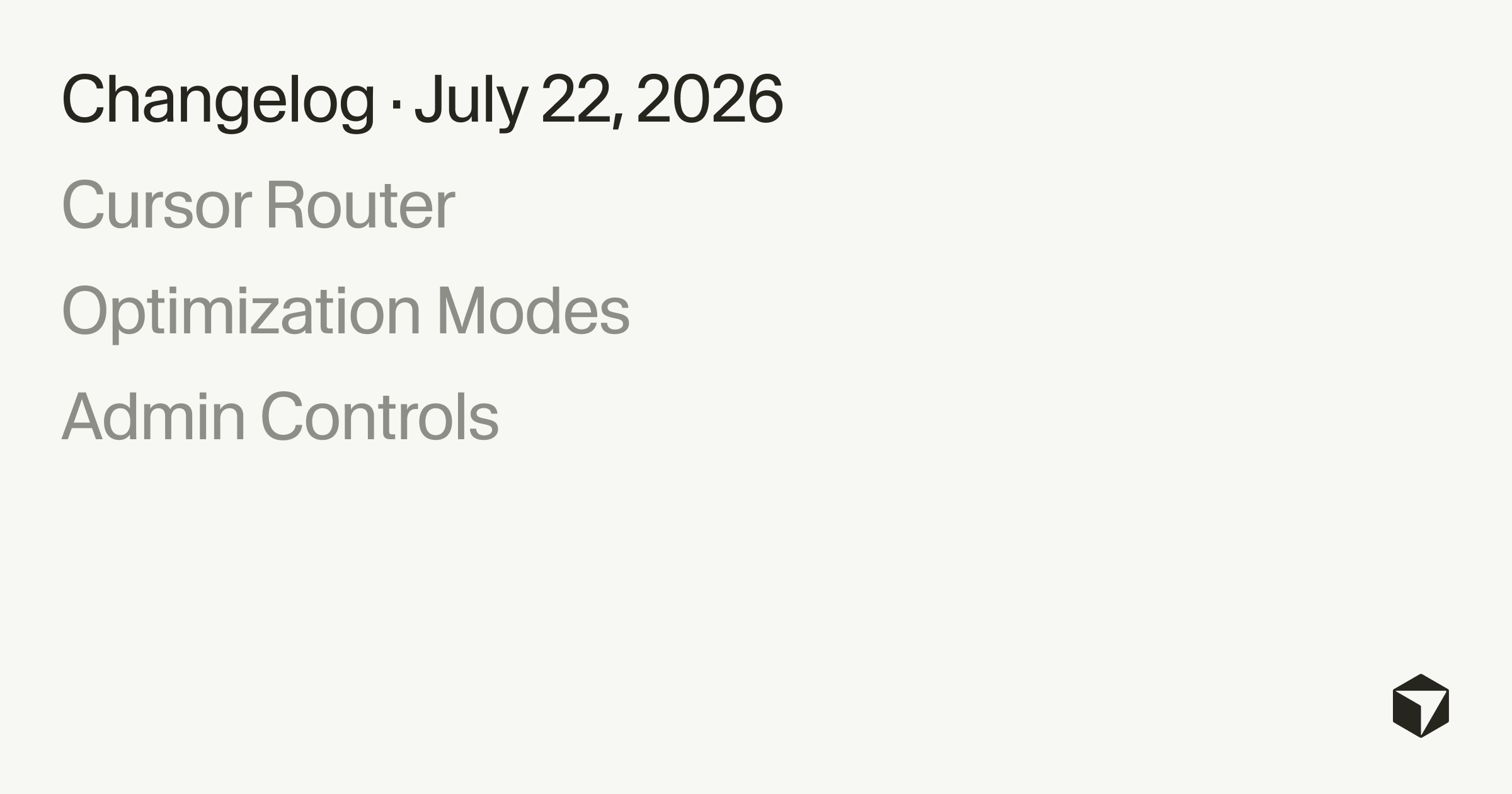
Cursor turns Auto mode into Cursor Router, an intelligent model router

Cursor shipped Cursor Router, which now powers Auto mode by classifying each request by task type and complexity and routing it to a frontier model or a price-efficient one.

Users pick an optimization target — Intelligence, Balance or Cost — and admins can enable the router per team or group, restrict which modes members use, set the default mode, and allow or block underlying models, with soft or hard enforcement for standardizing on Auto. The router is available across desktop, web, iOS, CLI and Cursor's SDK, is on by default for Teams plans, and requires Grok 4.5 as a price-efficient routing option.

Cursor turns Auto mode into Cursor Router, an intelligent model router
ptht05hbb1ssoooe.public.blob.vercel-storage.com

WHY IT MATTERS

Model routing is becoming the core cost lever inside agent harnesses — and Cursor is now shipping the policy controls enterprises were asking for.

TUE · Jul 21, 2026modelsgoogleagentsefficiencysecurity

Google ships three Flash-tier Gemini models and confirms Gemini 4 pre-training

Google introduced Gemini 3.6 Flash, 3.5 Flash-Lite and 3.5 Flash Cyber, aimed squarely at production agent workloads: 3.6 Flash cuts output token usage by 17% versus 3.5 Flash on the Artificial Analysis Index, and up to 65% on Datacurve's DeepSWE, at a lower cost per output token, while 3.5 Flash-Lite is pitched as the fastest, cheapest 3.5-class model.

3.5 Flash Cyber ships paired with the CodeMender code-security agent. Google also said Gemini 3.5 Pro is still testing with partners and that it has started our most ambitious pre-training run yet, for Gemini 4.

WHY IT MATTERS

Cheaper, more token-efficient Flash models plus a specialized cyber agent are direct inputs to any agent pipeline that has to survive a budget.

TUE · Jul 21, 2026open weightscodingagent harnessmodelspoolside

Poolside releases Laguna S 2.1, a 118B open-weight agentic coding model

Poolside released Laguna S 2.1, a 118B total and 8B activated MoE model with up to a 1M-token context in thinking and no-thinking modes, under the OpenMDW-1.1 open license and small enough to run on a single desktop.

It scores 70.2% on Terminal-Bench 2.1 in Poolside's own harness and is pitched as the most capable agentic coding model in its weight class, holding its own against models several times larger. Poolside says it went from the start of training to launch in under nine weeks and is publishing full trajectories for every benchmark trial it reports.

WHY IT MATTERS

A genuinely open-weight, laptop-class agentic coding model with published trajectories is the kind of reproducibility the open-weights crowd has been asking for.

MON · Jul 20, 2026computehardwareamdazureinference

Microsoft brings AMD's Helios rack-scale AI platform to Azure

Microsoft said Azure will add AMD's Helios AI platform and next-generation EPYC datacenter processors to its fleet, powering three upcoming offerings: HDv2 VMs for AI data systems and agentic workloads, HXv2 VMs for electronic design automation and technical computing, and ND MI455X v7 VMs for production-scale AI inference.

The move expands Microsoft's heterogeneous, multi-silicon strategy for inference and gives AMD its largest rack-scale design win yet in its push against Nvidia.

WHY IT MATTERS

Inference capacity and silicon choice set the floor on token prices, and AMD landing a hyperscaler is the strongest signal yet that the AI compute supply base is broadening.

MON · Jul 20, 2026copyrightlawsuitsanthropicpolicy

Judge approves Anthropic's $1.5B author copyright settlement — the first major AI-training case to close

US District Judge Araceli Martinez-Olguin granted final approval to Anthropic's $1.5 billion class-action settlement with authors who said the company trained Claude on pirated books, calling it meaningful relief for affected authors and publishers.

The deal covers more than 482,000 titles at roughly $3,000 per work, with about 91% already claimed by authors or publishers; the judge cut the requested attorney fee by $86 million, leaving $122 million for plaintiff counsel. It is the largest known copyright recovery in US history and the first major AI-training copyright case to reach full resolution, with parallel author suits against OpenAI and Meta still pending.

WHY IT MATTERS

The first resolved AI-training copyright case sets the price of the piracy claim and will shape settlement posture in every other author suit.