WEEK OF MAR 8 – 14, 2025

Gemma 3 put a ninth-ranked model on a single GPU the week OpenAI rebuilt its API around agents

A 27B open-weight model landed ninth on the human-preference arena, above DeepSeek-V3 and Meta's 405B flagship, and fits on one H100. Two days earlier OpenAI replaced Chat Completions and the Assistants API with a single agent-shaped endpoint.

Two things happened that will outlast the week. Google released Gemma 3 — a family of open-weight multimodal models whose 27B variant ranked ninth globally on LMArena, ahead of Llama 3.1 405B and DeepSeek-V3, while fitting on a single H100. That is a 27-billion-parameter model beating a model fifteen times its size on human preference.

OpenAI, meanwhile, spent its week reorganizing the surface developers build on: one Responses API replacing the split between Chat Completions and Assistants, an open-source Agents SDK, and three hosted tools — web search, file search and computer use — shipped as first-class primitives rather than things you wire together yourself.

WED · Mar 12, 2025open weightsgooglegemma 3multimodalvisionself-hostingcost

Google open-weights Gemma 3, and the 27B lands ninth on the arena above Llama 3.1 405B

Google DeepMind released Gemma 3 in 1B, 4B, 12B and 27B sizes under the Gemma Terms of Use, which permit commercial use with attribution. The models are multimodal for 4B and up — a 400M SigLIP vision encoder with pan-and-scan for flexible resolutions — carry a 128K-token context window, support more than 140 languages, and share a 256K-vocabulary tokenizer with Gemini 2.0, among the largest vocabularies in any open-weights release.

The numbers are the story. The instruction-tuned 27B reached an Elo of 1338 on LMArena, ninth overall, ahead of Meta's Llama 3.1 405B at 1269 and Alibaba's Qwen 72B at 1257, and roughly level with o1-preview. It scores 64.9% on MMMU — competitive with Gemini 1.5 Pro's 65.9% — and 89.0 on MATH against Gemini 1.5 Pro's 86.5, while staying behind the larger Gemini models on knowledge-heavy tasks like GPQA Diamond and SimpleQA. Google calls it the most capable model you can run on a single GPU or TPU: 54GB of weights in bfloat16 fits an H100, and quantization-aware training variants compress it to about 14GB.

Two caveats are worth stating plainly. The license is open weights, not open source — it carries distillation restrictions and is not Apache-2.0. And the model is weaker exactly where pretraining data volume wins, which is the honest boundary of what a 27B can do regardless of how well it is trained.
Google open-weights Gemma 3, and the 27B lands ninth on the arena above Llama 3.1 405B
Hugging Face

WHY IT MATTERS

This is a headline release, not a routine model drop. A 27B open-weight model at ninth on the human-preference leaderboard — above a 405B flagship and above DeepSeek-V3 — means the practical capability gap between a single-GPU download and a closed frontier API is now measured in a few arena positions rather than a generation. If you self-host anything, this is the checkpoint that changes what your floor looks like: vision, 128K context, 140+ languages and commercial rights on hardware you already own. Google simultaneously shipping an open model that beats its own prior commercial product and attaching distillation restrictions is the tension to watch — weights you can download is not the same thing as software you can fork.
WED · Mar 12, 2025googlegeminiimage generationmultimodaldeveloper tools

Gemini 2.0 Flash starts generating images natively inside the same model that handles text

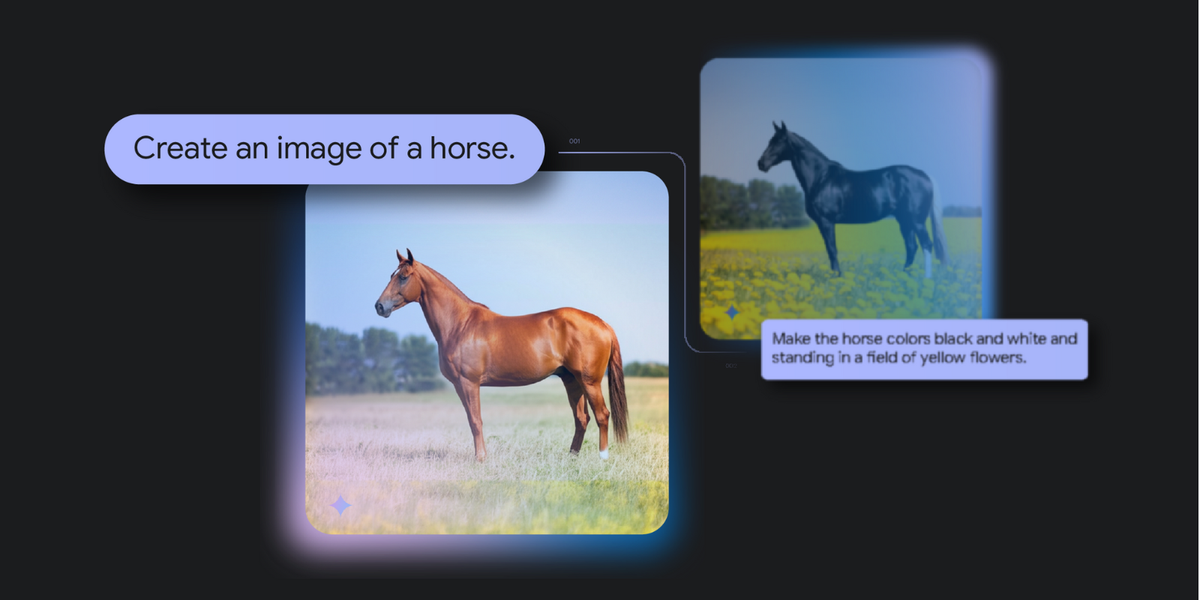
Google opened developer access to native image output in Gemini 2.0 Flash across all supported regions in Google AI Studio and the Gemini API, under the experimental identifier gemini-2.0-flash-exp. Because image generation lives in the same model that handles text, the capabilities are interleaved rather than separate: illustrate a story and keep characters and settings consistent across pages, edit an image across many turns of natural-language dialogue, and render long text inside images.

Google claims internal benchmarks put 2.0 Flash ahead of leading competitors on text rendering inside images — historically the weakest part of image generation — and notes the model leans on world knowledge and reasoning to decide what the right image is, while cautioning that its knowledge is broad and general rather than complete.

Gemini 2.0 Flash starts generating images natively inside the same model that handles text
storage.googleapis.com

WHY IT MATTERS

Read this as the setup for what lands two weeks later. Native image generation — image output as a modality inside the main model, not a handoff to a separate diffusion service — is the architecture that makes conversational editing work, and Google got it into developers' hands first. The unglamorous detail worth noting is interleaved text-and-image output: one model that can narrate and illustrate in a single pass is a different building block than a text model that calls an image API.

TUE · Mar 11, 2025openaiagentsapitool usecomputer useobservability

OpenAI ships the Responses API, an open-source Agents SDK, and three hosted tools

OpenAI announced the Responses API — a single endpoint that folds the simplicity of Chat Completions together with the tool use that previously lived in the Assistants API — alongside an open-source Agents SDK and three built-in tools: web search, which OpenAI says reaches 90% on SimpleQA using a GPT-4o-powered search, file search over vector stores with metadata filtering and reranking, and computer use, driven by the same model behind Operator and built to inspect screenshots, emit interface actions for code to execute, or work through a custom harness mixing visual and programmatic interaction.

The Agents SDK orchestrates single- and multi-agent workflows with handoffs, guardrails and tracing, and arrives as the successor to the experimental Swarm project. OpenAI is positioning Responses as a superset of Chat Completions and the long-term direction for building agents, with the Assistants API eventually deprecated. The framing in the announcement is that these are the same building blocks OpenAI uses internally for Operator and Deep Research.

WHY IT MATTERS

The most important thing here is that handoffs, guardrails and tracing became named primitives instead of conventions each team reinvents. A handoff that carries too little context produces amnesia; one that carries too much spreads secrets and noise — and now that decision has an API surface and a trace. For anyone building agents, tracing arriving as part of the platform rather than as an after-the-fact logging project is the part that reduces real operational risk. Note also the grazing pattern: three of the services OpenAI is now hosting — web search, file retrieval, code execution — are exactly the glue most teams had been maintaining by hand.